Why We Measure Your Nervous System Instead of Guessing

If you become a patient at Roots Chiropractic, your care starts with something you may not expect: we scan your nervous system before we build your care plan. Some people expect to walk in and get adjusted right away, so it's worth explaining why we work the way we do.
The simple reason: we don't want to guess. Scanning your nervous system gives us objective information about how your body is functioning, so your care is based on real data rather than assumptions. It's the difference between targeted care and a one-size-fits-all approach.

The Problem With Guessing
A lot of healthcare relies heavily on symptoms, where it hurts, what feels off. Symptoms matter, but they have real limitations as a guide.
For one, dysfunction can build for a long time before it ever produces noticeable pain. By the time something hurts, the underlying issue may have been developing for a while. For another, pain often shows up in a different place than its actual source. Treating only where it hurts can miss the real problem entirely. Relying on symptoms alone means working with incomplete information, and that leads to less precise care.
What Scanning Reveals
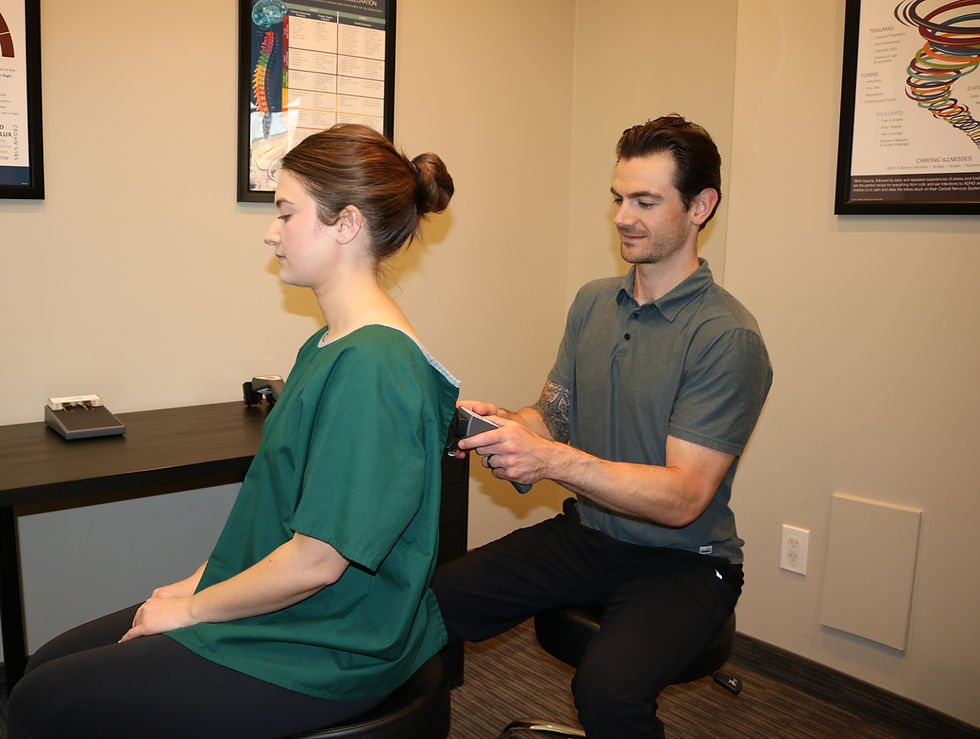
Our INSiGHT nervous system scans give us an objective look at things symptoms can't show. They reveal where stress and tension are concentrated along your spine, how your body is managing its overall stress response, and where there may be nerve interference or imbalance, including in areas that aren't yet causing you obvious problems.
This is information you simply can't get by asking someone where it hurts. It's a real, measurable picture of how your nervous system is functioning.
We Scan Again as You Progress
Here's the part that matters just as much: scanning isn't a one-time event at your first visit. We re-scan periodically throughout your care, roughly every twelve visits.
That's what turns your initial scan into something genuinely useful. It gives us a baseline to measure against, so we can see whether your nervous system is changing rather than relying only on how you happen to feel on a given day. Some days you feel great for reasons that have nothing to do with your spine. Objective data cuts through that noise.
Why This Makes Care Better
Measuring rather than guessing improves your care in a few concrete ways.
It makes care specific to you. Rather than applying the same general approach to everyone, we build your plan around what your nervous system actually needs. It targets the real source. By seeing where dysfunction is concentrated, we can address the true cause rather than just chasing symptoms. And it keeps us honest. If the re-scans aren't showing change, we need to know that and adjust our approach.
It Also Helps You Understand Your Body
There's another benefit that's easy to overlook. Most people have never been shown an objective picture of how their own nervous system is functioning. When we walk you through your scans, things tend to click. You see what's actually going on, why you've been experiencing what you have, and what we're aiming to address. That understanding makes you a real partner in your care rather than a passive recipient.
This Is What "Neurologically-Focused" Means in Practice
Measuring your nervous system isn't an extra step we tack on. It's the heart of what makes our care neurologically-focused. We center the nervous system, we measure it objectively, and we build everything around what we find.
See Your Own Scans
Most people have never seen an objective picture of how their nervous system is functioning. It's a genuinely eye-opening moment, and it's where real, personalized care begins. If you're anywhere across East Mesa and Gilbert, come see what we can measure and how we can help.
Become a new patient, or learn more about our adult chiropractic care.