What Chronic Stress Does to Your Nervous System

Stress is so normal in modern life that we often stop noticing it. But your nervous system notices. Chronic, ongoing stress doesn't just affect your mood. It creates real, measurable changes in how your body functions. Understanding what's happening is the first step to doing something about it.
Here's the core of it: your body has a stress response that's meant to switch on briefly in an emergency and then switch back off. Chronic stress keeps that response running when it shouldn't, and that takes a genuine toll on your nervous system and your whole body.

Your Stress Response, Briefly Explained
Your nervous system has two main modes. One is the "fight or flight" mode, designed for handling threats. Your heart rate climbs, your muscles tense, your senses sharpen, and your body diverts resources toward immediate survival. The other is the "rest and digest" mode, where your body recovers, repairs, digests, and restores balance.
In a healthy rhythm, you shift into fight-or-flight when needed, handle the situation, then return to rest-and-digest. The problem with modern life is that the stressors rarely stop, so many people get stuck in fight-or-flight far more than they should.
What Happens When You're Stuck in Stress Mode
When your nervous system stays in that heightened state, the effects accumulate throughout your body.
Your muscles stay tense, especially around the neck, shoulders, and spine, leading to chronic tension and pain. Your sleep suffers, because a wound-up nervous system struggles to power down. Your digestion can become disrupted, since the body deprioritizes it during stress. Your energy drains, because running in emergency mode is exhausting. And emotionally, everything feels harder to handle, because your system has less capacity left over.
Over time, this constant activation wears on you. It's not "just stress." It's a nervous system that's lost its ability to fully shift back into recovery mode.
The Spine and Nervous System Connection
Here's where chiropractic care enters the picture. Your spine houses much of your nervous system, and the two are deeply intertwined. When you're chronically stressed, the muscles around your spine stay guarded and tight, which can restrict how well your spine moves. That restriction can then feed back into keeping your nervous system on high alert. It becomes a self-reinforcing loop.
This is why addressing chronic stress isn't only about relaxation techniques. The physical state of your spine and nervous system is part of the equation.
How Chiropractic Care Helps
Chiropractic care can help interrupt that stress loop. By restoring proper movement to the spine and supporting better nervous system regulation, care helps your body shift out of constant fight-or-flight and back toward balance and recovery.
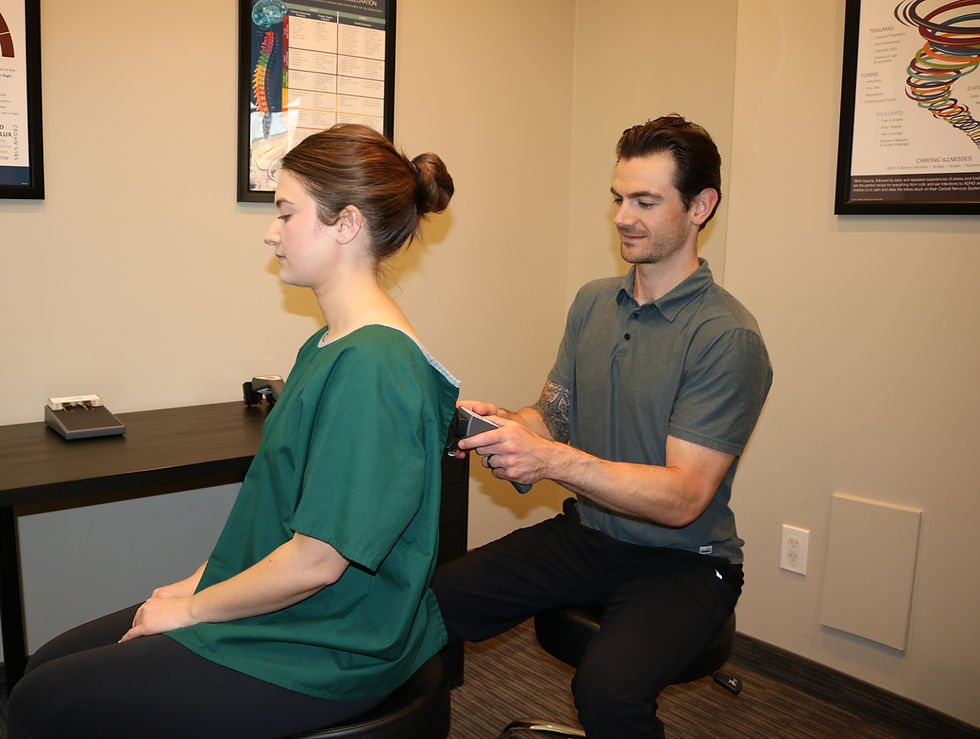
At Roots Chiropractic, our neurologically-focused approach is built around this. Your care starts with INSiGHT nervous system scans, which show us where stress and tension are concentrated in your body. That objective picture lets us address the specific areas where chronic stress has taken hold, and track your progress as your nervous system begins to regulate better.
Your Body Is Built to Recover
Here's the hopeful part: your nervous system is remarkably adaptable. It got stuck in overdrive, and with the right support it can learn its way back out. Care helps remove the interference holding it in that heightened state, so your body can find its way back to rest, repair, and calm.
You don't have to white-knuckle through chronic stress as if it's just your personality now. If you're in East Mesa, Gilbert, or Queen Creek, let's help your nervous system reset.
Start with a new patient visit and we'll show you what's going on and how we can help.